
Table of Contents
A warehouse is more than a place where goods are received, stored, picked and dispatched. Its day-to-day operations can reveal how effectively the wider supply chain is planned and coordinated.
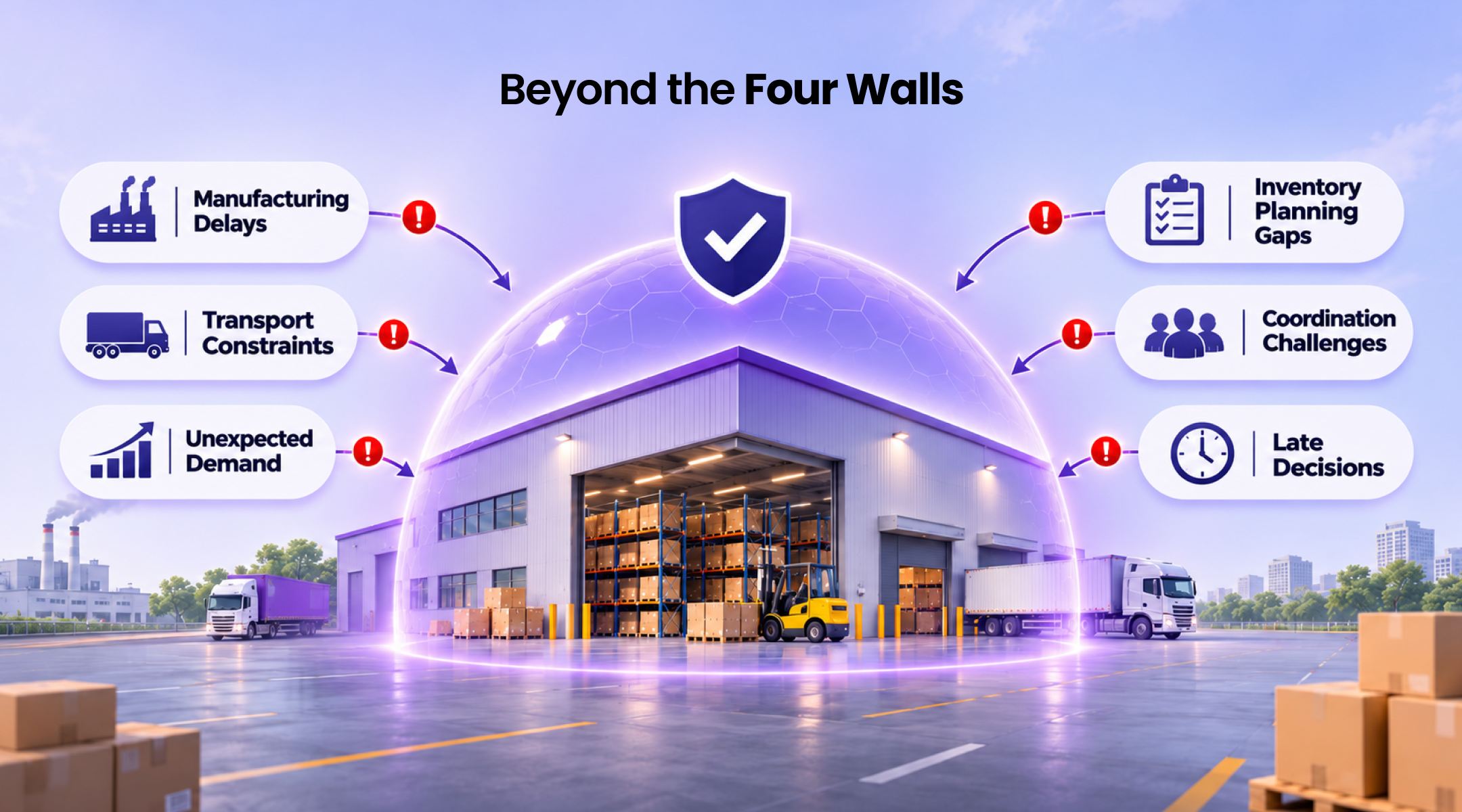
When inbound shipments arrive together, storage areas become congested or dispatches fall behind, the impact is felt within the warehouse. However, the factors shaping these situations may extend much further upstream, involving manufacturing schedules, transportation decisions, inventory planning and coordination across different functions.
This is what makes a warehouse an important indicator of overall supply chain performance. What happens within its four walls often reflects decisions made well beyond them.
The Warehouse as a Shock Absorber
Warehouses are commonly viewed as places where goods are received, stored, picked and dispatched. Yet their role in the supply chain is broader than these individual activities.
A warehouse helps absorb variations between supply and demand. It can hold inventory until it is needed, manage differences between inbound and outbound schedules, and provide some flexibility when demand changes unexpectedly.
In this sense, the warehouse acts as a shock absorber. It helps the supply chain manage uncertainty without requiring every upstream activity and downstream requirement to occur at exactly the same time.
However, this flexibility is not unlimited. Storage space, receiving docks, handling equipment, labour and dispatch capacity all have practical constraints. When the volume or timing of incoming goods exceeds what the operation can accommodate, the warehouse experiences that pressure directly.
The important question, therefore, is not simply whether the warehouse can handle its workload. It is whether the wider supply chain is creating a workload that the warehouse was designed and prepared to handle.
When Problems Outside the Warehouse appear inside it
Consider a manufacturer that experiences production delays. To recover lost time, it dispatches several shipments within a short period. The receiving warehouse, which planned for a more consistent flow of goods, suddenly faces multiple arrivals competing for the same docks, storage locations and handling resources.
The result may be congestion, additional handling and delays in making inventory available for orders.
Now consider a different situation. A transportation plan is optimised to maximise vehicle utilisation, resulting in several vehicles arriving at the warehouse around the same time. Although the transport plan may appear efficient in isolation, the combined arrival pattern places unnecessary pressure on receiving operations.
In both cases, the warehouse experiences the consequences of decisions made elsewhere.
Demand planning can create similar challenges. If inventory is not positioned appropriately ahead of an anticipated increase in sales, the warehouse may face urgent replenishment requirements alongside its regular workload. Alternatively, if inventory arrives too early or in quantities beyond immediate requirements, storage capacity can come under pressure.
These examples illustrate why warehouse congestion should not automatically be treated as a failure of warehouse execution. The underlying causes may involve upstream supply planning, transportation optimisation or a lack of coordination between functions.
Of course, warehouse processes and execution still matter. The point is to identify the actual source of a problem before deciding how to fix it.
Why Planning Decisions become Operational Problems
Supply chains consist of interconnected activities, but organisations often plan and measure those activities separately.
Manufacturing teams may focus on production targets. Transport teams may prioritise vehicle utilisation and delivery schedules. Commercial teams may pursue sales targets, while warehouse teams are measured on throughput, inventory accuracy and dispatch performance.
Each objective can be reasonable on its own. The difficulty arises when decisions that improve one function’s performance create additional pressure for another.
For example, a shipment consolidation decision may reduce transportation costs but produce an arrival pattern that overwhelms receiving capacity. Similarly, a commercial decision to accelerate a promotion may increase order volumes without giving warehouse and transport teams enough time to prepare.
Misaligned incentives can make these problems harder to resolve. If each function is accountable only for its own metrics, the wider operational impact of its decisions may receive insufficient attention.
Delayed decisions add another layer of difficulty. When changes to production schedules, demand forecasts or delivery commitments are communicated too late, warehouse teams have fewer options to adjust staffing, storage arrangements and operational priorities.
The resulting firefighting can appear to be a warehouse problem, even though the conditions that created it developed across the supply chain.
Why Collaborative Planning Matters
Preventing these problems requires planning that connects supply chain activities instead of treating them as separate functions.
Manufacturers, suppliers, transport teams, warehouse operators and third-party logistics (3PL) partners need a shared understanding of expected volumes, arrival schedules, inventory requirements and service commitments.
This does not mean every shipment or demand fluctuation can be predicted perfectly. Rather, it means that relevant information is shared early enough for teams to prepare, identify risks and make informed trade-offs.
A more collaborative approach can include:
- Coordinated inbound scheduling: Align expected shipment arrivals with receiving capacity and available handling resources.
- Shared demand and inventory plans: Give warehouse and transport teams better visibility into anticipated volume changes and replenishment requirements.
- Aligned operational measures: Evaluate decisions in terms of their impact on the wider supply chain, not just the performance of an individual function.
- Clear decision ownership: Establish who can approve schedule changes, adjust capacity and resolve conflicts between competing operational priorities.
- Regular performance reviews: Look beyond warehouse productivity figures to understand whether upstream variability, late information or downstream constraints are contributing to delays.
For businesses working with a 3PL partner, this collaboration is especially important. Outsourcing warehouse operations does not remove the need for the business and its logistics provider to coordinate planning, share information and agree on responsibilities.
The warehouse operator can manage the activities within its scope, but it cannot independently resolve every constraint created by the wider network.
Look Beyond the Four Walls
When warehouse congestion or service delays occur, the immediate priority is to restore operations. But clearing the backlog is only part of the solution if the same conditions continue to create problems.
A more effective response examines both warehouse execution and the decisions that shaped the workload. Were inbound arrivals aligned with receiving capacity? Were demand changes communicated in time? Did transportation and inventory plans support the warehouse’s operating requirements? Were the relevant teams working towards a shared outcome?
These questions help distinguish a local operational issue from a wider supply chain planning problem.
Ultimately, a warehouse should not be assessed in isolation from the network it serves. Its performance reflects not only the efficiency of its people and processes, but also the quality of the planning, coordination and decisions surrounding it.
The four walls may contain the warehouse operation, but they do not contain the causes of every warehouse problem. Understanding what happens inside them requires looking at the entire supply chain.
Frequently Asked Questions (FAQs)
How does warehouse performance reflect overall supply chain efficiency?
Warehouse performance reflects more than the efficiency of receiving, storage, picking and dispatch activities. It can also reveal how effectively manufacturing schedules, transportation plans, inventory positioning and demand forecasts are coordinated. Congestion or delays within a warehouse may therefore indicate problems elsewhere in the supply chain.
Why does warehouse congestion occur even when warehouse operations are efficient?
Warehouse congestion can occur when incoming shipments exceed planned receiving capacity, multiple vehicles arrive simultaneously or inventory reaches a facility earlier than required. These situations may result from production delays, transportation scheduling decisions or inaccurate demand planning rather than warehouse execution alone.
How does demand planning affect warehouse operations?
Demand planning influences the volume, timing and location of inventory that warehouses need to handle. Inaccurate forecasts or poorly communicated demand changes can create urgent replenishment requirements, excess inventory or unexpected pressure on storage and handling capacity.
What is the role of a warehouse as a supply chain shock absorber?
A warehouse acts as a supply chain shock absorber by holding inventory, managing differences between inbound and outbound schedules and providing flexibility when supply or demand changes. However, this flexibility is limited by available storage space, labour, equipment, receiving docks and dispatch capacity.
How can transportation planning affect warehouse capacity and productivity?
Transportation planning influences when and how goods arrive at a warehouse. For example, consolidating shipments or scheduling multiple vehicles within a short period may improve vehicle utilisation but create congestion at receiving docks. Coordinating arrival schedules with warehouse capacity can help reduce such operational pressure.
How can businesses prevent warehouse congestion through better supply chain coordination?
Businesses can reduce warehouse congestion through coordinated inbound scheduling, shared demand and inventory plans, timely communication of production changes and better alignment between transportation and receiving capacity. Clear decision ownership and regular performance reviews also help identify recurring constraints.
Why is collaboration between businesses and 3PL partners important for warehouse planning?
Effective warehouse planning requires businesses and their 3PL partners to share information about expected volumes, inventory requirements, arrival schedules and service commitments. Although a 3PL partner manages the warehouse activities within its scope, resolving wider supply chain constraints requires coordination between the provider and the business.
What should businesses investigate when warehouse delays keep recurring?
Businesses should examine both warehouse execution and the upstream or downstream factors influencing operations. This includes reviewing inbound arrival patterns, production schedules, demand forecasts, inventory positioning, transportation plans and communication between teams. Identifying the underlying cause helps prevent repeated firefighting.