
Table of Contents
A truck is running behind schedule. At the same time, a warehouse is preparing an order for dispatch, inventory is available at another location, and a customer is waiting for an update.
Individually, each team may have access to the information it needs. The transport team can track the vehicle. The warehouse team can check inventory and order status. The customer service team can see the delivery commitment.
But can the organisation bring all that information together quickly enough to decide what should happen next?
Should the dispatch schedule change? Is there an alternative vehicle? Can the order be fulfilled from another location? Does the customer need to be informed before the delay affects the delivery commitment?
These are not simply tracking questions. They are operational decisions, and the time taken to make them can determine how a supply chain responds to disruption.
For years, businesses have invested in dashboards, tracking platforms and reporting tools to improve visibility across their operations. Those investments have made information easier to access. However, visibility alone does not guarantee that the right action will follow.
The next challenge for supply chains is not just knowing what is happening. It is connecting information to decisions and decisions to execution.
The visibility revolution has changed the way supply chains operate
Supply chain visibility has come a long way. Warehouse management systems can record inventory movements and order fulfilment. Transportation management platforms can support vehicle booking, shipment tracking and freight payments. Fleet systems can maintain records of vehicle compliance and maintenance.
When these systems operate effectively, teams have a much clearer picture of their day-to-day operations.
However, a supply chain rarely operates through one system or one department. It involves warehouses, transport teams, suppliers, customers, finance functions and multiple operational partners. Each may generate information at a different point in the process.
This creates a familiar challenge: information exists, but it is not always connected in a way that supports timely decisions.
A warehouse may record that an order is ready, while the transport team is still arranging a vehicle. A fleet manager may know that a vehicle requires maintenance, but that information must also influence vehicle allocation. Similarly, an inventory update becomes more useful when the teams responsible for fulfilment and dispatch can act on it.
The issue, therefore, is not always the absence of technology. It can be the gap between the systems that capture operational information and the processes that need to respond to it.
Why another dashboard is not the answer
Dashboards are valuable. They help managers monitor performance, identify delays, review inventory positions and understand what is happening across different locations.
But a dashboard primarily presents information. It does not automatically resolve the operational issue behind that information.
Consider a warehouse approaching its available storage capacity. A dashboard might display occupancy levels, incoming stock and available space. That is useful, but the operations team still needs to determine what to do.
Should incoming stock be rescheduled? Can available space be reorganised? Is another warehouse better placed to receive the inventory? Will the change affect transport costs or customer commitments?
The answers depend on more than one metric. They require information from different parts of the operation, an understanding of the constraints involved and coordination between the people responsible for execution.
This distinction is becoming increasingly important as supply chains adopt more advanced technologies.
According to PwC’s 2026 Digital Trends in Operations Survey, which covered 767 operations and supply chain leaders at US companies, 89% of respondents said their technology investments had not fully delivered the expected results. Furthermore, 87% said poor data quality had affected their ability to achieve value from digital initiatives.
These findings highlight an important point: investing in more technology does not automatically translate into better operational outcomes. The information must be reliable, systems need to work together, and the resulting insights must influence how work gets done.
From visibility to decision intelligence
This is where decision intelligence becomes relevant.
At a practical level, decision intelligence brings together operational data, business rules, analytics and human judgement to help organisations make better-informed decisions.
Rather than treating every system as an independent source of information, the objective is to connect relevant data and understand how a change in one part of the supply chain affects another.
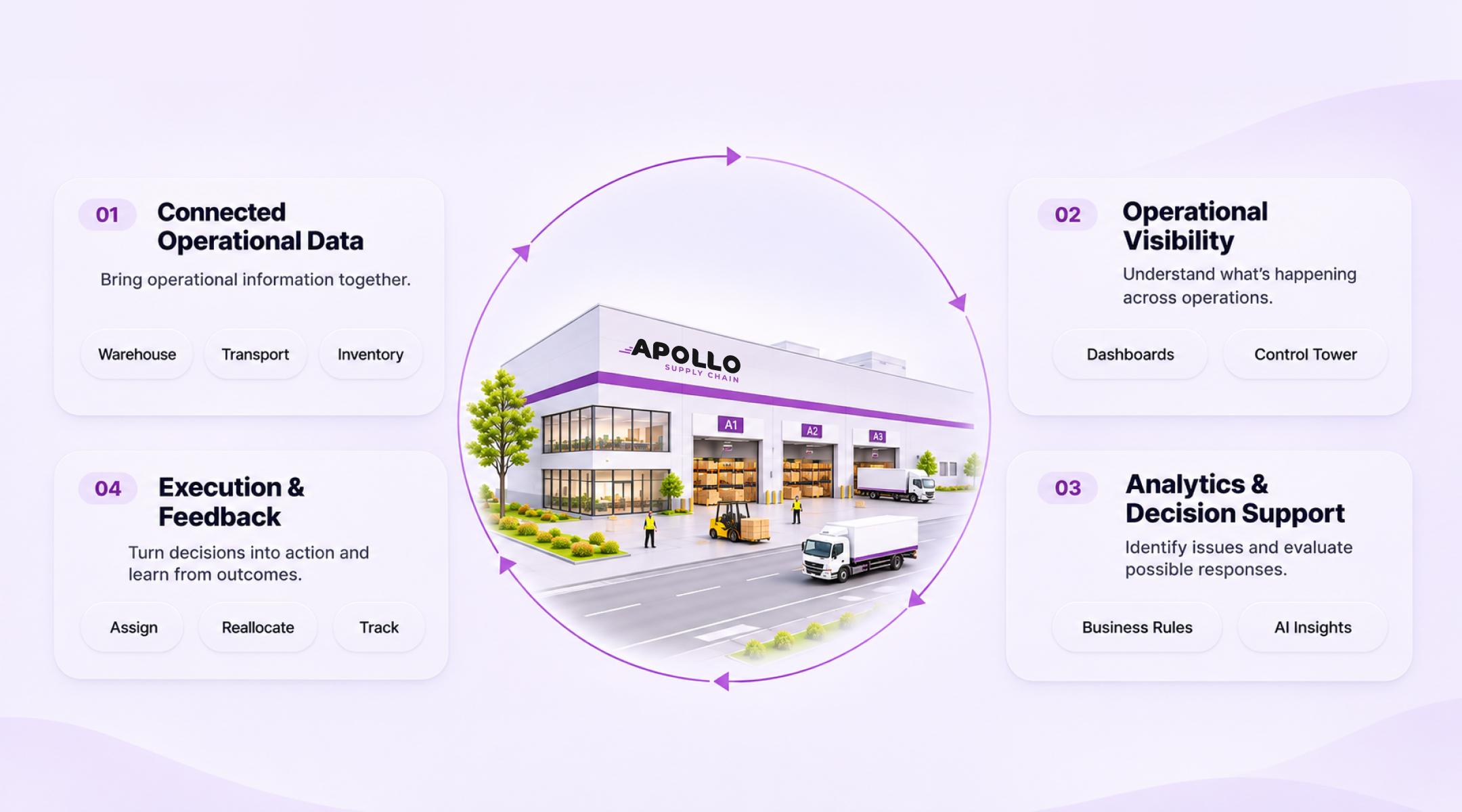
A connected decision-making environment typically involves four important layers.
1. Connected operational data
The first requirement is reliable information from the systems that manage everyday activities.
This can include:
- Warehouse management systems (WMS) for inventory, storage and order execution.
- Transportation management systems (TMS) for vehicle booking, shipment tracking and transport payments.
- Fleet management platforms for vehicle availability, maintenance and compliance.
- Dispatch systems for shipment preparation and confirmation.
- Reverse logistics platforms for managing returned goods.
- Financial and workforce systems for expenses, assets and labour-related information.
When these systems exchange relevant information, teams can work with a more consistent operational picture.
However, integration is not simply about connecting applications. Data must also be accurate, timely and meaningful to the people or systems using it.
2. An operational visibility layer
Once information is available, it needs to be presented in a way that helps people understand the situation.
A control tower, analytics platform or operational dashboard can bring together information from multiple sources and highlight important changes.
For example, a logistics manager may need to understand:
- Which shipments are delayed?
- Which vehicles are available for allocation?
- Which warehouse locations are approaching capacity?
- Where are inventory movements not progressing as planned?
- Which orders require immediate attention?
The purpose is not to display every available data point. It is to make the information relevant to the decision at hand.
3. Analytics and decision support
The next layer involves interpreting the information.
Rules, analytical models and, where appropriate, AI can help identify patterns, flag exceptions and evaluate possible responses.
For instance, if a shipment is delayed, a system could bring together the shipment’s status, vehicle availability, delivery commitment and relevant operational constraints. This would help the responsible team assess whether a revised schedule or an alternative arrangement is practical.
Similarly, warehouse data can help identify changing utilisation patterns or picking bottlenecks before they become larger operational problems.
The value lies in moving from a simple alert to a more useful understanding of the issue and the available options.
4. Execution and feedback
A decision only creates value when it leads to an action.
That action may involve assigning a vehicle, changing a dispatch sequence, reallocating inventory or escalating an exception to the right person.
Some actions can be handled through predefined workflows and business rules. Others require a supervisor or manager to review the available information and approve the next step.
The outcome should then be recorded so that teams can understand whether the action resolved the issue.
This creates a continuous loop: operational data informs decisions, decisions guide execution, and execution generates new information.
What does a decision-oriented supply chain look like in practice?
Consider a business preparing for a period of high demand.
Orders begin increasing across multiple locations. The warehouse team needs to manage picking volumes, inventory availability and labour allocation. Meanwhile, the transport team must plan vehicle availability, dispatch schedules and delivery commitments.
If these activities are managed through disconnected systems, teams may end up reacting to problems separately.
A more connected operating environment changes the way the situation is managed.
Step 1: The systems capture operational changes.
Warehouse and order systems record inventory movements, incoming orders and fulfilment progress. Transport and fleet systems provide information about vehicle availability and shipment movement.
Step 2: The operation identifies exceptions.
The visibility layer helps highlight areas that require attention, such as a sudden increase in pending orders, a vehicle constraint or a warehouse approaching its operating capacity.
Step 3: The team evaluates possible responses.
Relevant information is brought together so that managers can assess the available options. This may involve changing task priorities, reviewing dispatch schedules or coordinating resources between locations.
Step 4: The decision moves into execution.
The approved action is communicated to the teams responsible for carrying it out. The resulting status is recorded in the relevant operational systems.
Step 5: The operation learns from the outcome.
Teams can review whether the response worked, identify recurring bottlenecks and use those observations to improve future planning.
This is what makes connected decision-making different from simply monitoring operations. It brings information, coordination and execution into the same operational conversation.
The next evolution: AI-assisted supply chain decisions
Artificial intelligence is likely to play a growing role in this transition.
The industry conversation is already moving beyond predictive analytics towards AI systems that can interpret operational information, work through multiple steps and support specific business workflows.
Gartner’s 2026 supply chain technology research identifies agentic AI, collaborative multi-agent systems, intelligent simulation and decision governance among the emerging technologies shaping supply chain operations.
In logistics, potential applications include identifying shipment exceptions, evaluating alternative responses, supporting warehouse task allocation and helping teams manage documentation or other repetitive workflows.
However, it is important to distinguish between an AI-generated recommendation and an action that has been approved and executed.
A system may identify a delay and suggest an alternative vehicle. But that recommendation still needs to account for vehicle availability, route requirements, cost, delivery commitments and operational constraints.
Likewise, automating a decision without reliable data or appropriate oversight can introduce new risks rather than solve existing problems.
For this reason, the future of supply chain decision-making will depend on more than AI models. It will require connected systems, reliable data, well-defined workflows and clear accountability.
The objective should not be to automate every decision. It should be to make routine decisions more efficient, complex decisions better informed and exceptions easier to manage.
Building technology around the way supply chains actually operate
For technology to make a meaningful difference, it must reflect the realities of the operation it is designed to support.
At Apollo Supply Chain, this approach begins with building technology close to the processes it is intended to manage. Its in-house technology ecosystem brings together nine platforms covering warehouse management, transportation, fleet, dispatch, reverse logistics, workforce, assets and expenses.
These platforms address different operational requirements while sharing data with one another and with external systems.
For example, the Warehouse Management System supports inventory and warehouse execution across client sites. Transport Management supports truck booking, tracking and payments, while Fleet Management provides visibility into the compliance and upkeep of the fleet.
The ecosystem also includes VisionWare, a digital twin of the warehouse that uses live WMS data to provide an interactive view of inventory, space utilisation and picking activity.
This combination is important because warehouse execution, transport movement and operational visibility are closely connected. Information from the warehouse can help teams understand picking and inventory activity, while transport and fleet systems support the movement of goods beyond the warehouse.
The same principle extends to other business functions. Dispatch Management supports the tracking and confirmation of materials sent to OEM customers. Reverse Logistics manages the return flow of goods, while workforce, asset and expense platforms support the resources and administrative processes behind daily operations.
The broader objective is to ensure that technology remains connected to the work taking place on the ground.
As supply chains become more complex, this connection between operational execution and digital visibility will become increasingly important. It provides a foundation on which more advanced analytics and decision-support capabilities can develop.
Technology should help the supply chain move forward
The conversation around supply chain technology often focuses on the newest platform, the most advanced dashboard or the next AI application.
But the real measure of progress is not how many systems an organisation has adopted. It is whether those systems help people understand what is happening, make informed decisions and coordinate the right response.
Visibility remains essential. Without reliable information, decision-making becomes difficult. But visibility is only one part of the process.
The next stage is about connecting operational data with business rules, analytics and execution — while keeping people accountable for the decisions that matter.
The supply chain of the future will not be defined by how much information it can display. It will be defined by how effectively it can turn that information into action.
Frequently Asked Questions (FAQs)
What is decision intelligence in supply chain management?
Decision intelligence in supply chain management combines operational data, business rules, analytics and human judgement to help businesses make better-informed decisions. It connects information from different functions so teams can understand operational issues, evaluate possible responses and coordinate execution.
How is decision intelligence different from supply chain visibility?
Supply chain visibility helps businesses understand what is happening across their operations, such as shipment delays, inventory movements and warehouse activity. Decision intelligence goes a step further by helping teams interpret that information, evaluate available options and determine what action to take.
Why are supply chain dashboards not enough for effective decision-making?
Dashboards present operational information, but they do not automatically resolve the issues behind it. A delayed shipment, for example, may require teams to consider vehicle availability, delivery commitments, inventory positions and alternative arrangements before deciding how to respond.
What systems are needed to build a connected supply chain?
A connected supply chain may involve several systems, including:
- Warehouse Management Systems (WMS)
- Transportation Management Systems (TMS)
- Fleet Management Systems
- Dispatch Management Systems
- Reverse Logistics Platforms
- Financial and Workforce Management Systems
These systems need to exchange relevant, accurate and timely information to support coordinated operations.
How can analytics improve supply chain decision-making?
Analytics can help identify operational patterns, highlight exceptions and evaluate possible responses. For example, warehouse data can reveal changing space utilisation or picking bottlenecks, while shipment and fleet information can help teams assess alternatives when deliveries are delayed.
What role does AI play in supply chain decision-making?
AI can support supply chain decisions by identifying exceptions, interpreting operational information, evaluating possible responses and assisting with repetitive workflows. However, AI-generated recommendations still need to account for business constraints and appropriate human oversight before actions are approved and executed.
What is the role of a supply chain control tower in decision intelligence?
A supply chain control tower brings together operational information from different systems to provide a more consolidated view of activities. It can help teams monitor shipment delays, vehicle availability, inventory movements and warehouse capacity, making it easier to identify exceptions that require attention.
How does Apollo Supply Chain use technology to connect logistics operations?
Apollo Supply Chain has an in-house technology ecosystem comprising nine platforms covering warehouse management, transportation, fleet, dispatch, reverse logistics, workforce, assets and expenses. These platforms address different operational requirements while sharing data with one another and external systems, helping connect information across business functions.